
Watch the full interview here: https://youtu.be/tNM_N_OkKjI?si=wdeA756MyMyDoHJ6
Medicare and Medicare Part D cause more anxiety for people over 65 than almost any other topic we cover — figuring out which plan is right for you, and worrying about hidden costs, especially prescription drug costs through Part D, is a huge concern for anyone managing a chronic condition.
To help make sense of it all, I sat down with Margaret Johnson, a family nurse practitioner with extensive experience in functional health care for diverse populations. Margaret holds a bachelor’s degree in sociology from Occidental College and a master’s in sociology from California State University, Los Angeles, along with an associate degree in nursing and a master of science in nursing from Azusa Pacific University. She’s a clinical nurse specialist in medical-surgical nursing, a board-certified family nurse practitioner, and has been honored by the Sigma Theta Tau National Nursing Honor Society and the Sigma Kappa Delta National Sociological Honor Society. Margaret is also an ACLS and BCLS instructor with significant research experience, including FDA clinical trials and conference presentations. She currently practices at the Hubert Humphrey Comprehensive Health Center, where she focuses on implementing functional medicine programs.
Can you start by walking us through the four parts of Medicare?
Let’s start with Part A, which covers hospital, hospice, and home health services. Most people get this automatically because they’ve worked for more than 10 years and contributed to Social Security. That’s an important point I make to my patients: even if you’re tired and ready to retire, it’s worth working past that 10-year mark. If you start collecting Social Security without enough contribution history, you’ll be hit with a surcharge based on your income, billed monthly, for not having contributed enough. Women in particular don’t always do as well on Social Security, so getting more into that account can help you avoid the surcharge altogether.
Part B covers your outpatient expenses — doctor’s visits, X-rays, diagnostics, and labs. There’s a cost to this, usually deducted directly from your Social Security or railroad pension check, and it’s pegged to your income. The key thing to remember is timing: once you leave your job and your employer-provided insurance, you have eight months to apply for Parts A and B and start paying for them, or you’ll face a yearly surcharge that keeps climbing with inflation for the rest of your life. So the two big takeaways here are to work at least 10 years if you can, and to get your coverage started within that eight-month window after you retire or leave your employer coverage.
Part C is where things get interesting — this is the decision between Traditional Medicare and Medicare Advantage. Medicare Advantage was introduced under the Bush administration as a way to save money by moving people into managed care organizations that limit which doctors and hospitals you can use. Traditional Medicare is widely accepted by clinics, hospitals, and doctors because it pays for what’s medically necessary, and you can see the specialists and use the hospitals you choose, with no delays. Medicare Advantage, by comparison, typically comes with about a 25% reduction in covered fees and privileges right out of the gate, and everything has to be approved — if you want to see a cardiologist, your primary care provider has to justify the referral, and you can be denied. That leads to real delays in care, sometimes months, while your primary and a specialist go back and forth. One advantage Medicare Advantage plans often do have is better information sharing, since many use a shared electronic record system that specialists and primary care providers can both access. With Traditional Medicare, that sharing isn’t automatic — as a primary care provider, I often have to get a signed consent from the patient just to request records from their specialists, and those delays in getting information can genuinely affect the care decisions I make. If you’re on Traditional Medicare, always ask for copies of your visit notes, labs, and diagnostics from every specialist and bring them to your primary care visit — it prevents tests from being repeated and wasted healthcare dollars.
What role does a primary care provider play in all of this?
Having one central coordinating person — an internist, a geriatrician, or a primary care nurse practitioner like myself — is essential. I’m a full-scope provider, which means I have a license that allows me to practice independently without physician supervision, though many nurse practitioners do work under a physician who reviews a percentage of their decisions. Having that one central person who understands adult medicine, who can hold all your data and refer you to the right specialists, matters enormously. It’s part of a broader trend toward bundled care — functional medicine and holistic practices in the private sector are increasingly offering physical therapy, occupational therapy, behavioral health support, and even life coaching in one place. It’s not always perfectly bundled, but if you look for it, that kind of coordinated care is out there. And ultimately, it comes back to being an active, informed participant in your own healthcare — the more you understand about the system you’re navigating, the more powerful an advocate you can be for yourself.
Now let’s talk about the part that surprises everyone — Part D.
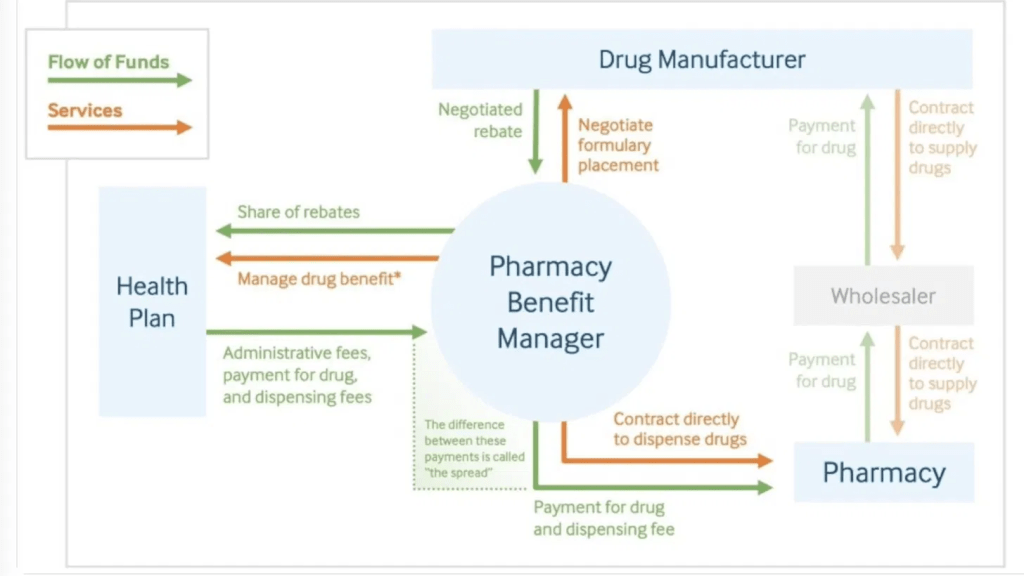
Part D is where your pharmacy benefit manager, or PBM, comes in. Picture the healthcare map: your dollars enter through your health plan, and your primary care provider is your advocate and coordinator within that system. A large share of that money flows to the pharmacy benefit manager, which decides your formulary — which drugs are covered, and at what tier. Generic, tier-one drugs usually carry a small copay, maybe $5. Tier two starts to get noticeably more expensive, and tier three can become unaffordable for a lot of people.
Here’s how the PBM makes those decisions. Generic drugs are inexpensive, but drug companies have to wait roughly seven years — sometimes as long as eleven for more complex drugs — before a drug can go generic and come off patent. In the meantime, pharmaceutical companies are very good at making a small tweak to a drug’s molecular structure and releasing it as a “new” brand-name drug, which resets that patent clock and keeps the price high, even if it works about the same as an older, cheaper alternative like losartan or lisinopril. The PBM is trying to balance a formulary of drugs that are effective, available, and treat major diseases, while giving your primary care provider and health plan some flexibility to get you the right medication.
This is also where prior authorization comes in, and it’s a real burden on providers. For one medication, I might have to fill out a three-page form and document the entire history of every other drug I’ve tried with a patient, just to justify a single prescription. On top of a full patient schedule, the electronic medical record adds an average of two hours a day — at least eight hours a week — of documentation time on top of patient care. That’s part of why a visit can start to feel rushed: providers are managing a packed schedule and hours of paperwork most patients never see. If a provider seems short with you, it’s often not personal — they usually have a full waiting room and hours of documentation still ahead of them.
You mentioned we should know “who owns what” in this industry — can you explain?
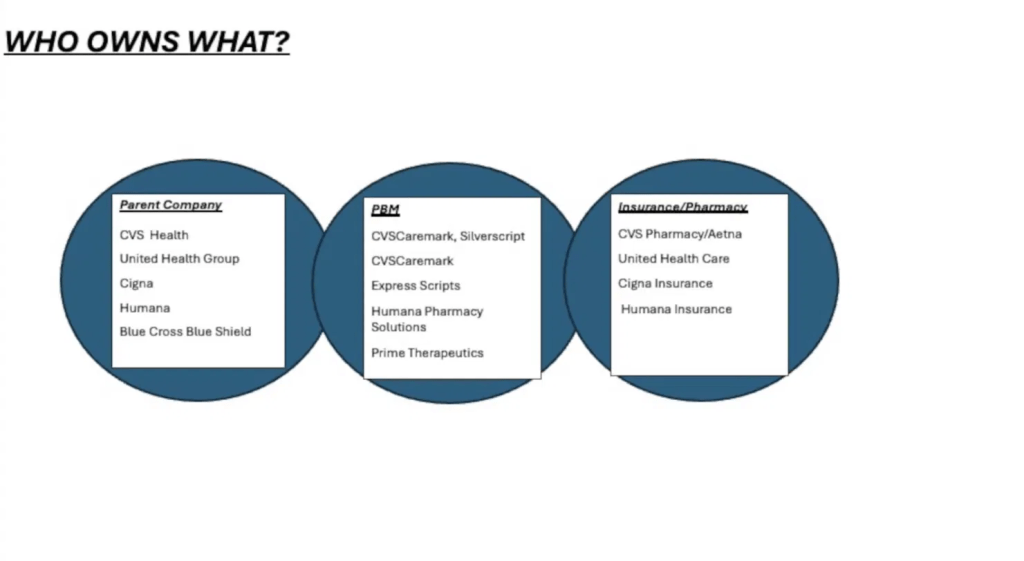
You’ve probably noticed familiar pharmacies like CVS and Rite Aid closing locations, leaving empty buildings behind. That’s a symptom of major consolidation across the healthcare industry. Your health plan and your medical group increasingly own their own pharmacy benefit management companies, and in turn their own pharmacies — CVS is a good example of this vertical structure. As one company buys another, and another, competition disappears, and less competition generally means higher prices for consumers.
What about Medicare patients with very low income?
Many of us cover part of our healthcare costs with a Medigap, or supplemental, plan that we pay for ourselves. For people who can’t afford that, there’s Medicaid in most of the country, or Medi-Cal here in California — you have to apply through your county welfare office; it isn’t automatic just because you’re on Medicare. One thing that surprises a lot of people moving from Medicaid or Medi-Cal onto Medicare is that Medicare doesn’t cover over-the-counter items like vitamins or basic pain relievers the way Medicaid often does, since Medicare becomes your primary insurance. There’s real uncertainty right now about the future of these programs. The Affordable Care Act allowed people earning up to 138% of the federal poverty level — around $15,800 a year for an individual in 2025 — to get Medicaid or Medi-Cal without a copay, but those supports look like they may be scaled back as the government looks to cut costs, which would mean copays for people who currently have none, and could push others off eligibility entirely based on Social Security or retirement income. It’s also worth knowing that Medicaid and Medi-Cal require periodic paperwork to maintain eligibility — missing a deadline can get you dropped from the plan even while your Medicare stays active, so staying on top of that paperwork, or getting help with it, really matters.
Why do you emphasize building basic computer skills so much?
Because more and more of this system now runs through the internet, and it’s becoming harder to get help by phone as offices are understaffed. Being able to access your Social Security account online, message your provider through a patient portal, and look up plan deadlines can genuinely make your life easier and help you stay on top of your care. Many of my patients are on Facebook and comfortable with a cell phone, but don’t know how to send a secure message through our patient portal — that gap can be a real barrier. Apple, for what it’s worth, offers free classes and strong customer support if you’re looking for a place to start, and setting up your voicemail and getting comfortable with texting can go a long way too.
Are there any recent policy changes that have actually helped patients?
Yes — the Inflation Reduction Act, passed in 2022, gave the federal government the ability to negotiate directly with major drug companies to bring prices down, something it had been barred from doing since Medicare Advantage was first introduced under the Bush administration. That negotiating power helped bring down the price of insulin, which had climbed to hundreds of dollars a month for some patients. Under the act, ten expensive drugs a year are now subject to price negotiation, split between very high-cost drugs — for conditions like hepatitis C or rare diseases — and drugs used by very large numbers of patients, like those for hypertension, heart failure, and diabetes. There’s real uncertainty about whether this provision will survive under the current administration, so if this matters to you, it’s worth letting your elected officials know. There was also a helpful change in 2026: the roughly $2,000 out-of-pocket cost that used to hit all at once every January can now be spread out over 12 months instead.
What are the most common mistakes people make when they first enroll?
The number one mistake is not confirming that your longtime doctor or provider is actually in-network for the Medicare Advantage plan you’re choosing — providers can move in and out of networks, and if you’re on an Advantage plan and see someone out of network, you’ll pay significantly more. This isn’t a concern with Traditional Medicare. The second mistake is not confirming your medications are covered at a tier you can afford — every plan publishes its drug tiers, and it’s worth checking before you enroll, since that list can change. The third is not being realistic about the care you’ll need as you age. If you can no longer drive, for example, a plan that offers home health visits could matter a great deal, even if it wasn’t a priority when you first signed up. It’s worth revisiting your plan choice periodically as your circumstances change, rather than assuming the plan you picked years ago is still the best fit.
What are your top three takeaways for our audience?
First, do your research — AARP is a good, reliable source with side-by-side comparisons of Medigap and Advantage plans. Second, make sure you genuinely understand the difference between Traditional Medicare and Medicare Advantage before you choose. And third, choose the plan that actually fits your needs — be realistic about your health and circumstances, and stay informed.
 Fifty UP